Critical to the profitability of commercial vehicle construction repair services is the skillful selection of technology, equipment and proper implementation of the entire system in the service. While more and more often workshop owners and managers understand perfectly well the necessity for the company to equip itself properly, insufficient training of the crew is still a common mistake. It even happens that there is none at all. According to service technicians’ accounts, the fault often lies with the technology provider.
Service design
During contacts with investors, and this is usually the stage after the purchase of the plot of land, obtaining of permits and execution of the construction project, it turns out that now they are just wondering what they would like to do in this site. When asked if they have a design for the site’s technology, investors tend to react with surprise and question the need for it. Unfortunately, it is all too common to encounter a situation where an investor skips the basic stage of planning and designing a car service. This problem applies both to services designed for repairing vehicles up to, and above 3.5 t GVW. The basic stage of planning the construction of a car service, regardless of its purpose, is the creation of technological assumptions. It would seem incredible, but this is a stage that is very often neglected by investors. Of course, some assumptions are made, but a comprehensive approach to the creation of a comprehensive technological design of the service is necessary. The real bane is construction projects that do not take into account the needs of implementing the organization of repair and diagnostic stations. Most design companies do not have sufficient experience related to the design of automotive service stations, and commercial vehicle service stations in particular. It’s not a sin, but it is a sin not to assist with professionals with experience in organization and technology.
Planning a repair station
When planning the technology, it is crucial to optimally locate the support truss in the floor of the hall, which will provide a direct base for conducting repairs. It is very important to make an appropriate, thoughtful choice of the location of the stand, since in this case it is “eminently stationary” and it will not be possible to easily change its location in the future. As always, much depends on the specifics of the service and the planned capacity of the accident repair department. If the intention is to carry out ad hoc repairs, there is no need to create unnecessary infrastructure, extended stations equipped with overhead cranes, etc. However, if the plan was to create an accident repair center serving a large area of land or a group of transport companies, or carrying out orders from insurance companies, the problem should be approached much more comprehensively. One of the key factors in equipment selection should be their design and the resulting durability, reliability and ergonomics. Ideally, interchangeable elements handled by employees should be made of materials with the lowest possible weight and be easy to assemble and disassemble. It has become standard to use components made of lightweight alloys with high mechanical performance, which are equivalent to steel alloys in this regard.

Photo: working elements made of high-grade light alloys
Support truss
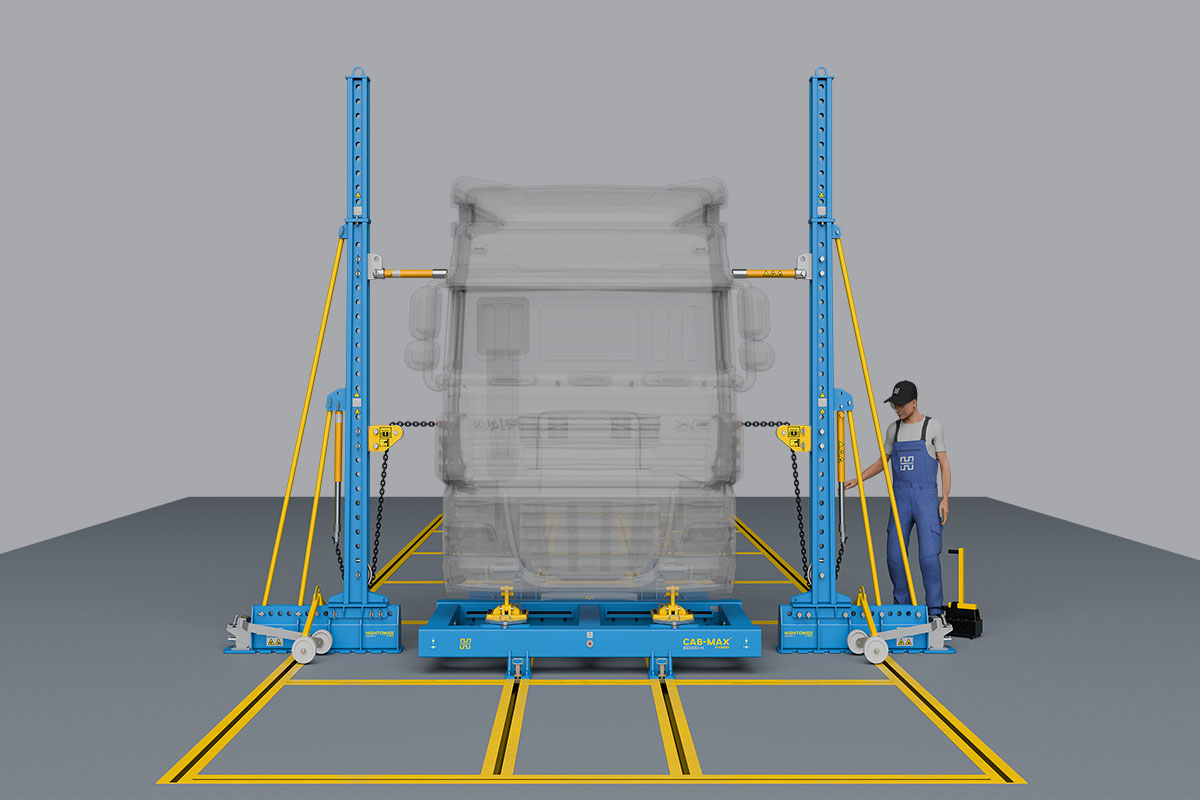
As a standard, it is recommended that one support truss of 16 m in length and 4.5 m in width be constructed. It will be designed for both the installation of vehicles during frame repair and the mounting hardware of the driver’s cab, which will be repaired after their removal from the vehicle. To increase the capacity of the stand, an additional truss of the same dimensions can be made, but an equally good, proven solution is to make a 16 m x 4.5 m truss and an additional 4.5 m x 4.5 m truss for cab repair.

Fig. Truss

Photo: Method of attaching work equipment to the support truss
Frame repair equipment
The main components of a standard frame repair kit are: two horizontal presses, a dam, two vertical presses, four supports, a “C” press, and chain brackets holding the frame. It is worth noting the system for supplying hydraulic cylinders, which is driven by compressed air from the service installation. There are two systems: with a multipath transducer (pump) that allows simultaneous connection and control of several devices, and the option of supplying separate pumps for individual repair equipment. Although both solutions have their supporters and opponents, based on contacts with a great many repair services around the world, one can say with conviction that there are more advantages to using separate power supplies for all devices in the system.

Photo: press and horizontal dam system during frame repair

Photo: press type “C”
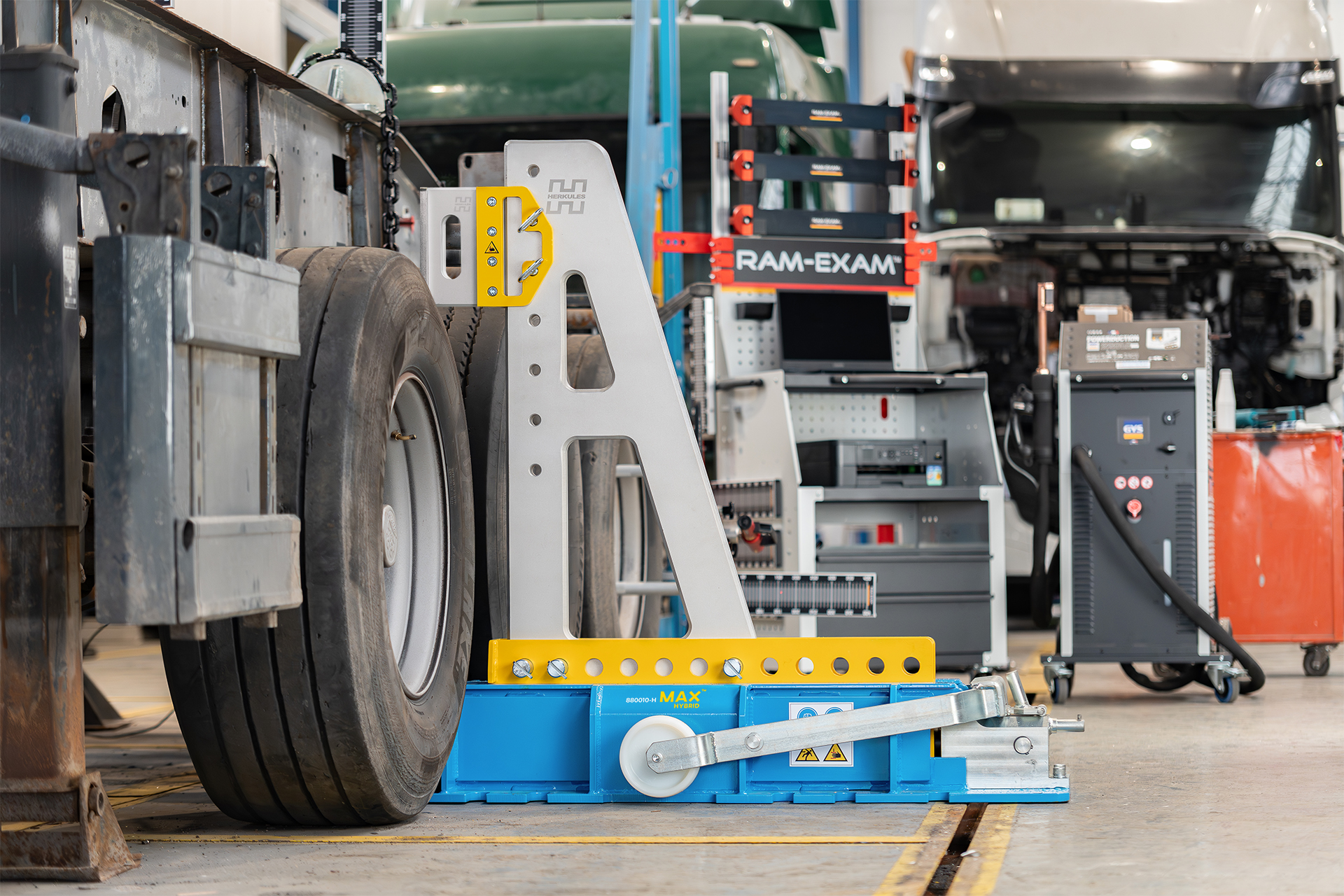
It is also necessary to use auxiliary equipment in the form of roller mounts for securing the vehicle frame during straightening, caps to prevent unwanted deformation of the vehicle frame edges during the impact of the press system, and spreader systems.

Photo Attachments that are necessary during repairs

Photo: Vertical press with pneumatic lifting assistance
Induction heater
Can a vehicle frame be heated without losing strength performance? Yes, and even you should, but this requires vigilance and accurate dosage of the heat supplied. When straightening a structure “cold”, most often there are micro-cracks in the structure of the material from which the frame is made. Heating allows the metal crystals to move more easily during the straightening forces. The question of whether it is safe for the frame must be answered honestly, that any damage and repair by straightening must have negative effects on the structure of the vehicle. It is important not to exceed the safety limit. Cars are designed with a certain safety margin and minor interference does not make the vehicle unsafe. The key is, for example, the temperature to which the repair zone is heated. It should not exceed 650 degrees Celsius, because above this limit steel alloys irretrievably lose mechanical properties given to them in the production process. When heating with a torch, it is not possible to fully control the temperature, because the component is not heated “on the inside”, but the heating occurs “from the outside” of the frame, and by the time the inside heats up to the expected temperature, its outer layers will already be seriously overheated.

Fig. Comparison of performance of induction and gas burner
In addition, the process takes so long that there is unwanted heating of adjacent zones making straightening difficult. The safety aspect is also not without significance. The solution is to use high-performance induction heaters. The heating process is performed point-wise in the desired zone and takes place almost simultaneously over the entire volume of the frame plane, while adjacent zones are not heated excessively.
Overhead cranes and cranes
Carrying out repairs on commercial vehicles often requires the use of auxiliary equipment when disassembling and assembling vehicle components. This applies to disassembly of cabs as well as engine and other vehicle assemblies. The most convenient is the use of an overhead crane, but this solution is relatively expensive and justified only in the case of a large number of conducted repairs. Very convenient from the point of view of organization and cost is the use of a manual chain winch mounted on a specially made support beam. This may not be a solution that gives full mobility, but for ad hoc work it is completely sufficient.
Auxiliary equipment and sheet metal tools
When conducting post-accident repairs of cabs, buses and vehicles that have sheet metal plating components, it is necessary to use basic technologies analogous to those for passenger cars. The basic equipment is an inverter welder for welding high-grade sheet metal, a welder with the possibility of soldering, and other tools of the modern sheet metal worker.
Diagnostic equipment
It is difficult to imagine a doctor proceeding with surgery without performing a diagnostic on the patient. How to treat when it is not known exactly what is the cause of the infirmity and the ailment with which the patient reported? Unfortunately, it is all too common in the accident repair industry for sheet metal workers to repair a vehicle using the “successive approximations” method. It is true that the experience possessed, is a serious argument in favor of the so-called old professionals. No one intends to detract from the knowledge and integrity of this worthy group of professionals. However, it is worthwhile to interest them in the possibility of speeding up their work and improving quality not only by using direct repair tools. In the case of skillful implementation of the repair system, service employees can be successfully interested in the methods of diagnosis and measurement by showing that it is an integral part of the technological process.
Commercial vehicle accident repair service should two diagnostic systems:
- For measuring the shape of frames,
- Axle and wheel system geometry.
Optimal post-accident repairs are those carried out in the correct technological cycle that allow not only to restore the correct shape of the vehicle frame but also to repair it taking into account the geometry of the chassis. This is not too complicated provided the appropriate measurement technologies are used.
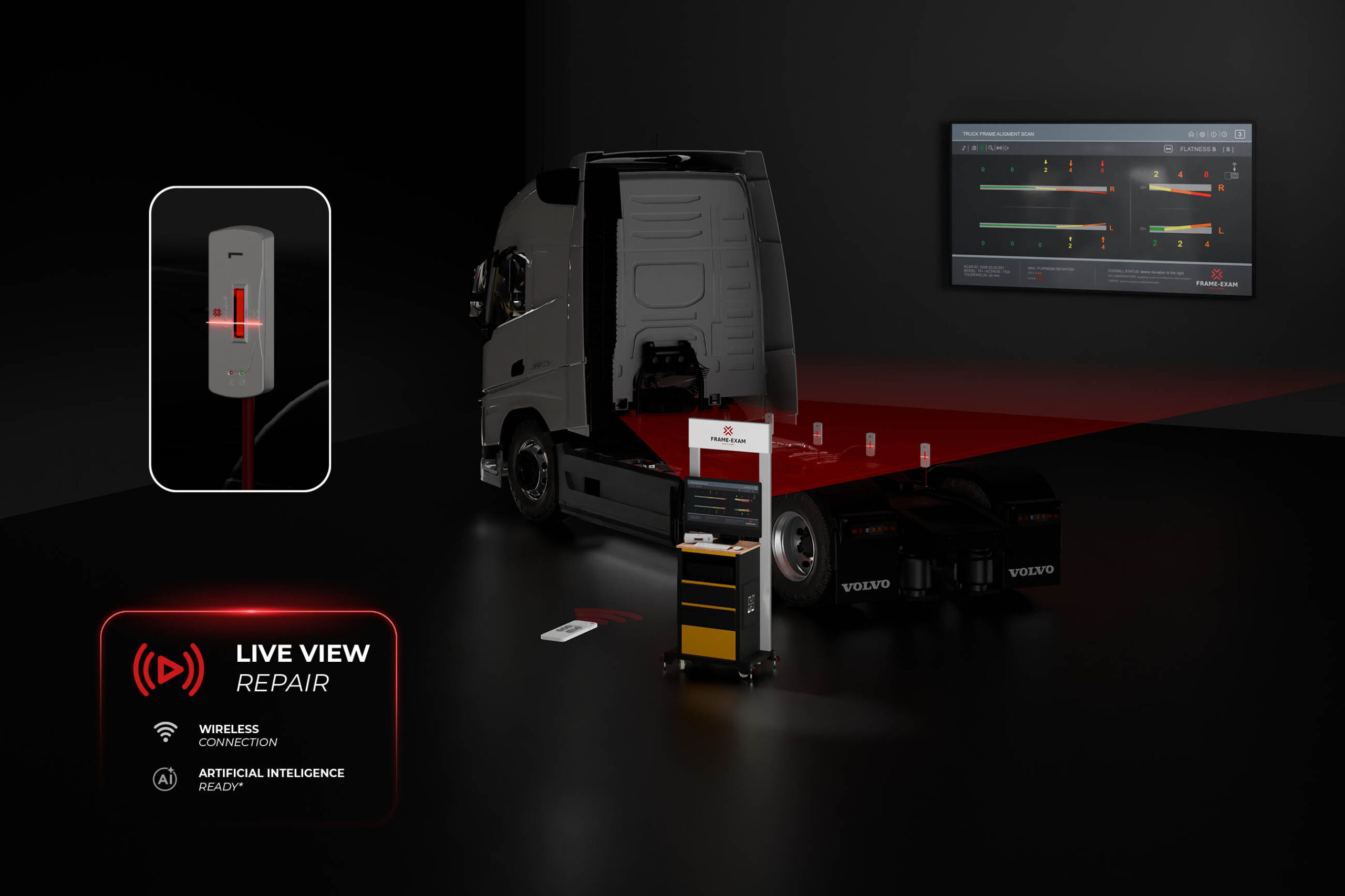
The diagnostic system should make it possible to check the shape of the frame and be able to check, and at the same time adjust, the basic parameters of wheel and axle geometry.
Diagnostics
After the initial straightening of the subframe, it is necessary to check the geometry of the non-adjustable axles and, in case of deviations, it is necessary to correct their alignment with respect to the center axis of the subframe already at this stage. In this way, serious trouble can be avoided in the final phase of repair involving the final adjustment of the chassis alignment. This is one example of the desirability of continuous control of frame shape and wheel and axle geometry. In practice, very different cases often arise, in which it even proves indispensable to assist with a diagnostic system. It should be noted here that for the proper rolling of the vehicle’s wheels it is not enough to take care of wheel alignment. Equally important are the angles of inclination and advance of the axles of the steering pins, whose role in the entire diagnostic and adjustment process is still underestimated. The name “knuckle pin axles” is already a historical name (but also officially used in the OSKP Law) that does not accurately reflect the modern design of the car’s suspensions, but after reading the definition of this parameter, it is easy to understand what it is all about.

Photo Diagnosing the chassis system

Photo Diagnosing the shape of the frame
Accident repair vs. in-service straightening
In the case of vehicles up to 3.5 t GVW, the need for operational vehicles is not encountered. The overwhelming majority of cars in this group are self-supporting or frame-and-self-supporting structures. This type of bodywork is not subject to operational straightening,but only to post-collision and post-accident repairs and possible reconstruction. The situation is different with vehicles above 3.5t GVW, where the subframe structure is very often twisted during use. It happens as a result of overloading, uneven road surfaces or during the installation of tractor-trailers. In-service straightening is sometimes very helpful, and in some cases even necessary, to prepare a vehicle for chassis alignment. Admittedly, it is the alignment of the wheel system and axles relative to each other that determines the rolling quality of the vehicle, but too much deviation in the shape of the frame can make it much more difficult or even impossible to effectively adjust certain parameters. It is crucial, for example, to pre-position the perpendicularity of the fixed axis(es) with respect to the center of the subframe. An additional complication is the diagonal curvature and twisting of the frame. Especially in the case of built-in vehicles, there are defects that are difficult to diagnose without the use of appropriate diagnostic equipment.
The article deals with the basic problems of organizing and planning the construction of service facilities for vehicles over 3.5t mainly related to technical conditions and technology. The commercial vehicle market is very interesting not only because of the number of vehicles moving around our country, but also Poland’s position as one of the leading freight carriers in Europe. Investment in the service of accident repair and operation of commercial vehicles, is a very serious decision that requires careful adherence to planning and implementation, step by step with the participation of specialists.
read more
Latest Posts
When planning post-accident vehicle repairs, the technological elements that do