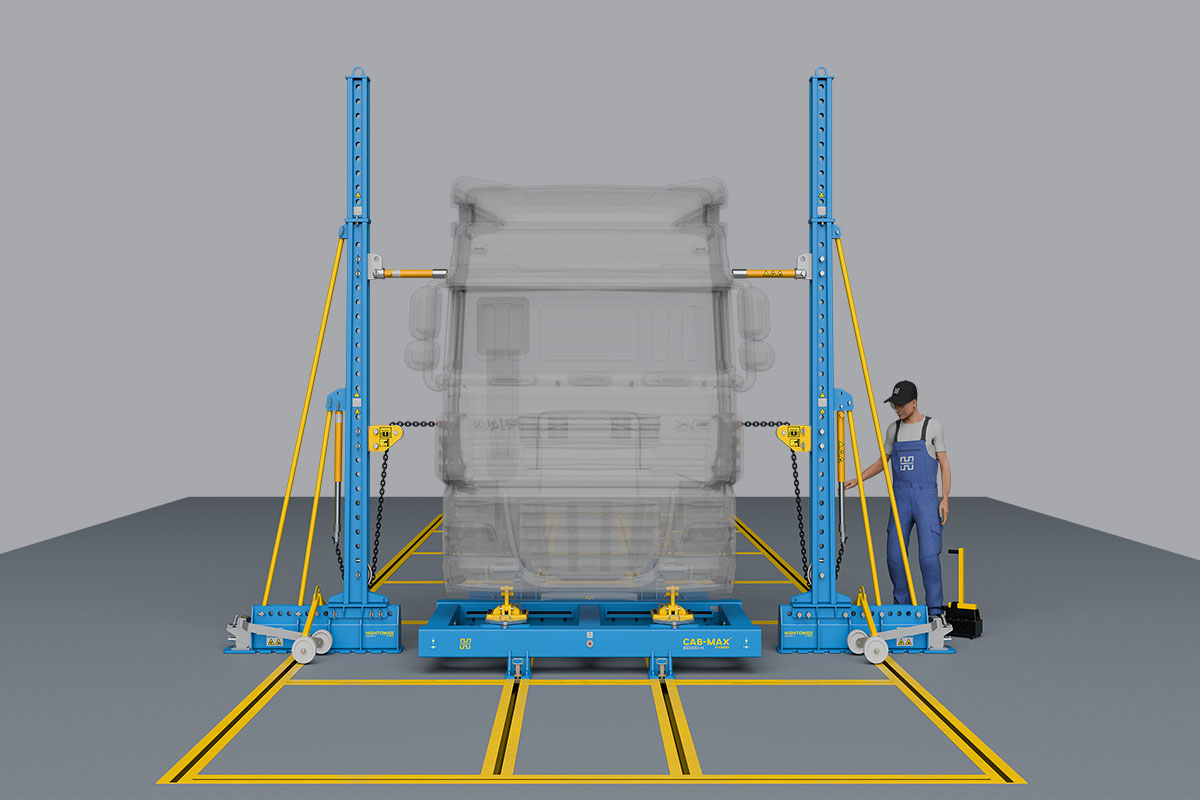
Despite the fact that road transport is the basis of most logistical activities for both freight and passenger transportation, the problem of repairing commercial vehicle frames is very poorly described in the technical literature. Looking for information in scientific papers and even on the Internet, one gets the impression that the subject is virtually nonexistent. It is true that there are some more detailed analyses of the strength of welded joints, or descriptions of tests of the strength parameters of the frame structure depending on the welding methods used, but is this what the motor vehicle damage repair service sector expects? Certainly, no.
The publication of the article is related to the 1st Safe Vehicle Repairs Conference organized by Bydgoszcz University of Technology and the Institute of Body Technology.
Vehicle frames
The frame is the most important load-bearing part of a truck. It is not, as some claim, part of the chassis. The frame is the load-bearing element to which the other parts of the vehicle, including the suspension, are attached. Perhaps at this point the previous order that many who read these words have held until now is shattered, but if so, all the more reason to pay attention. The task of the frame is to provide the vehicle with the right rigidity depending on its purpose. There are vehicles for transporting goods with low weight, but also those that not only have to be prepared for heavy loads, but in addition work in very heavy conditions. Examples include large dump trucks or truck cranes. By the way, it is worth mentioning that commercial vehicles are subject to deformation of the superstructure not only in the event of a road collision, but also during operation. Hence the concept of in-service straightening, which I extracted during the creation of an innovative repair line for commercial vehicles. Frames have a very different design, mainly depending on the load capacity and purpose of the vehicle. The most common is the longitudinal structure, which is widely used, for example, in tractor-trailers and semi-trailers. A longitudinal frame is usually built from two longitudinal support beams connected by multiple cross members. Research and many years of experience have shown that this design performs well in even the most difficult conditions and allows it to maintain adequate mechanical properties at a relatively low tare weight. For the sake of order, it is worth systematizing the main division of frames due to their construction:
- cross,
- stringers,
- spatial.
In addition, it should be noted that there are also frames fused to the vehicle floorboard, partial frames, auxiliary frames and truss frames (such as in buses). An interesting case of a vehicle frame is the so-called intermediate frame designed for use with interchangeable bodies depending on the purpose of the vehicle. It is mainly encountered in the construction of trailers.

Photo Damaged tractor-trailer frame
Due to the mechanical loads they carry, frames are made of so-called high-grade steel. These are mainly low-alloy steels with higher strength, such as 18G2 and 18 G2A. In order to increase yield strength, the steels currently used have reduced phosphorus, sulfur and carbon content. Instead, they contain minor additives, resulting in a value of 570 MPa. An interesting addition to the alloys used in frame construction is copper. The insignificant addition of this element (max. 0.45%) makes it possible to significantly reduce the susceptibility of steel to corrosion resulting from harsh weather conditions and salt contamination.
Can the frames be repaired?
You can, but it should be done in accordance with the art. This means that if the repair operations do not destroy the structure of materials (e.g., by overheating), replace damaged components to a degree that precludes their repair, and restore the geometry of the entire structure, then it can be considered that there are no other contraindications besides economic aspects.
It all starts at the stage of assessing the extent of the damage. The proper selection of damage into repairable and replaceable components is a key moment in the claims process. Due to technological difficulties, it seems that the repair of a riveted frame can cause the most problems. This refers to the restoration of riveted joints with technical parameters similar to those obtained during production. Riveting requires the use of riveting equipment and high-quality rivets, and the forces required to rivet the frame reach several hundred kilonutons. Welded connections appear to be easier for accident repair service and special body companies. However, these are only appearances. It is not easy to make a proper welded joint that complies with the manufacturer’s technology to guarantee the restoration of the original strength of the joint and the expected mechanical properties of the frame. It is important not only how, but also by what method the connection is made. In addition, manufacturers often indicate exactly how to prepare frame components for the welding process, as well as the possible use of reinforcements. Some frames must not be welded during the repair process, but only in the case of modifications or adaptation to special bodies, but again only according to vehicle manufacturers’ documentation.

Fig. Example of a proper repair by means of welding with reinforcement

Fig. Repairing a crack by welding
Bolted frame repair seems to be the easiest. One thing worth noting is that most repairs, whether accident or operational, involve the process of straightening frame components. Often, during straightening, local heating occurs. Heating the straightening area is, within certain limits, an even desirable process, since the structure of the material has an easier task in mild deformation. However, it is crucial to follow a basic rule: never heat the steel component being straightened above the limiting temperature of 650°C.

Fig. Patterns of the dependence of an element’s color on its temperature
To reduce the dead weight of a vehicle, most structural parts are made of high-grade metal alloys, mostly steel. Overheating of a high-grade alloy with enhanced mechanical properties results in their irreversible loss. Unfortunately, during training and consultations with employees of commercial vehicle repair shops, it appears that basically NO ONE follows this basic rule. However, if there is someone who applies heating without exceeding the temperature limit, I return the honor. Unfortunately, this will only be the exception that confirms the rule.
Measurements and diagnostics
An essential and integral part of the vehicle repair process is its measurements. This applies equally to the subframe and the chassis. Most important for the process of vehicle operation are the correct parameters of chassis geometry, which are sometimes related to the shape of the substructure. There is a noticeable lack of thorough knowledge regarding the principles of both frame and chassis geometry of vehicles. Ubiquitous misleading theories, myths, as well as the process of constant replacement of personnel in repair services are not conducive to raising the level of familiarity with these issues among service technicians. During a post-accident repair, it always starts with restoring the frame geometry, and for the whole process to run smoothly it is necessary to use a measuring system.

Fig. Vehicle frame measurements (from left): 1 – measurement of the center axis deviation of the frame, 2 – measurement of the lateral curvature of the frame beam, 3- measurement of the twist of the frame
Measuring the shape of the frame seems very logical and understandable, and relatively easy to do with the various methods available. However, special attention should be paid to the shape defect of torsion. Without the use of appropriate measuring equipment, it is very difficult to control this property. Especially how the vehicle’s components are attached to the frame.
Axles and wheels are attached to the frame. The geometry of the chassis system has a direct impact on the degree of safety of moving vehicles, as well as the economy. This is no different for commercial vehicles, and the possible economic aspect is very significant, as it relates to the cost of tires, fuel consumption and suspension components. In the case of these vehicles, the matter is often more complicated, as they are often multi-axle. Chassis geometry is defined as a set of angular relationships describing the alignment and mutual positioning of all the vehicle’s road wheels. The parameters concern both the position of the wheels measured relative to the plane on which the vehicle stands (wheel camber) and the alignment of the steering components (steering pin measurements). The measurements also concern steering angles. By inspecting all the driving wheels, the axes of the chassis system are determined (e.g., the geometric axis of travel), which makes it possible to measure axle deviations, as well as the subsequent correct alignment of all axles.

Fig. Chassis system vs. vehicle frame
In the case of measuring vehicles with a frame structure, the measurement is usually made with reference to the vehicle’s subframe. It is worth noting here that the most important thing is that the entire axle and wheel system of the vehicle is properly aligned. The matter of the shape of the frame is a separate issue.
It should be remembered that before proceeding with repairs, especially with welding technology, it is necessary to perform a thorough analysis of both economic and technological. It is on this analysis that the correctness of the repair decision depends, as well as the correct application of methods for its implementation. Wanting to be sure of a safe frame repair, it is necessary to follow all the recommendations of the vehicle manufacturer and the general rules of work in accordance with art. It is worth being inquisitive and reaching out to sources of information developed by vehicle manufacturers. Quite a lot of material can be found on the Internet, and although it may not be very comprehensive, but it will certainly be helpful.
read more
Latest Posts

When planning post-accident vehicle repairs, the technological elements that do
Critical to the profitability of commercial vehicle construction repair services